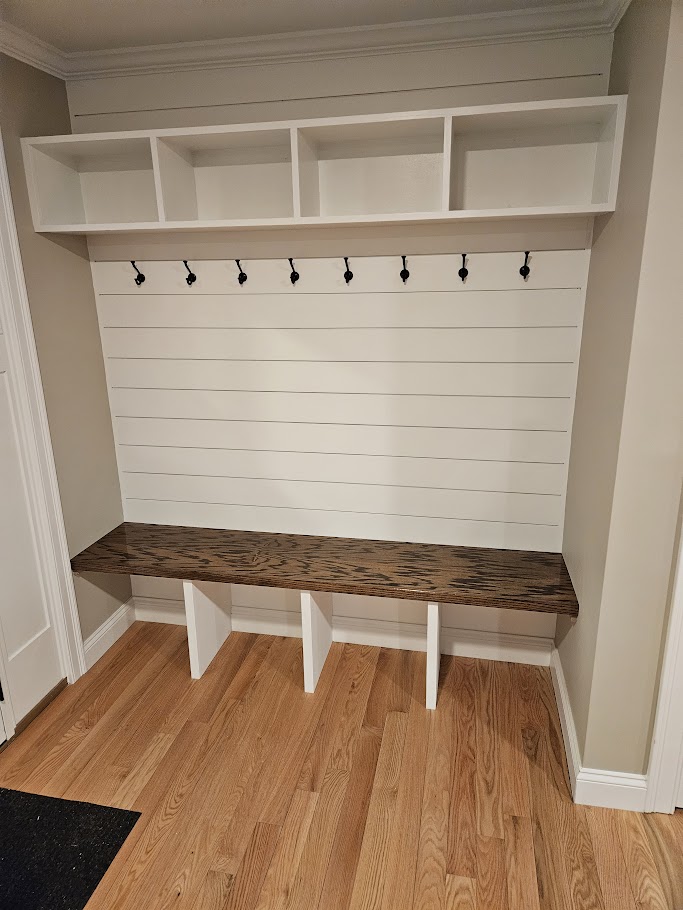
Quick answer: "Carpenter-led" means the person who designs the plan for your project is the same person who picks up the tools and builds it. At Toensing Construction, owner Colby Toensing is the lead carpenter on every job. He is not a project manager coordinating subcontractors from a distance, but the person on site, hands-on, personally accountable for the work from the first cut to the final coat of finish.
What "Carpenter-Led" Actually Means
In a lot of remodeling companies, the person who sells you the job isn't the person who builds it. A sales rep or estimator writes the contract, a project manager schedules subcontractors, and the actual carpentry gets handed off to whichever crew is available that week. Nobody in that chain necessarily has hands-on carpentry experience themselves, and nobody who does have that experience was in the room when the scope was decided.
Carpenter-led construction flips that. The person who walks your home, understands what you actually want, and writes the plan is a working carpenter who will also be the one executing it. That means the plan gets shaped around what's actually buildable and what will actually last, not just what sounds good in a proposal.
How It's Different from a Typical General Contractor
A general contractor's core skill is coordination: lining up electricians, plumbers, framers, and finish crews, and keeping a schedule and budget together across all of them. That's a real skill, and plenty of GCs are excellent at it. But coordination is a different job from carpentry, and a GC who isn't personally swinging a hammer is relying entirely on whichever subcontractor shows up that day to make good decisions on the fly.
A carpenter-led company still coordinates the specialty trades a project needs. Electrical and plumbing work still gets done by licensed electricians and plumbers. The difference is in the core carpentry: framing, built-ins, trim, millwork, and finish work are done by the same person who scoped the job, project after project, rather than being subcontracted out to a rotating crew.
Why It Matters for Your Project
Three things tend to follow from a carpenter-led approach:
Fewer surprises mid-project. When the person who wrote the plan is also building it, problems that only become visible once the walls are open, such as old framing, hidden water damage, or an out-of-square wall, get solved by someone who already understands the full scope and budget, instead of being escalated up a chain of people who weren't there for the original conversation.
Direct accountability. There's no ambiguity about who's responsible for the quality of the finish work. It's the same person from the walkthrough to the final punch list.
Fewer projects running at once. A carpenter-led model doesn't scale the way a subcontractor-heavy model does. There's only one Colby. Toensing Construction deliberately limits how many projects run concurrently so that personal attention doesn't get diluted.
What to Expect Working with Toensing Construction
Projects start with a free on-site consultation, not a sales pitch. From there, pricing and scope are laid out honestly, including where costs could shift once work is underway, rather than a lowball number designed to win the job. Toensing Construction works across historic home restoration, kitchen and bathroom remodels, ADU construction, and custom carpentry (built-ins, millwork, decks, and porches) throughout Warren and the East Bay, with availability statewide across Rhode Island.
Frequently Asked Questions
Is carpenter-led construction more expensive than hiring a general contractor?
Not inherently. Pricing depends on project scope, materials, and site conditions the same way it would with any contractor. What changes is where the money goes: less spent on coordination overhead and subcontractor markup, more of it tied directly to the person actually building your project.
Does a carpenter-led company still use licensed electricians and plumbers?
Yes. Specialty trades that require their own licensing are still subcontracted to qualified professionals. "Carpenter-led" describes who leads the core carpentry and overall project direction, not a claim that one person does every trade.
Is this approach better for historic restoration specifically?
It tends to help. Historic work often surfaces exactly the kind of mid-project judgment calls, like matching an original profile or working around settled framing, that benefit from having the same experienced person making the call from start to finish, rather than relaying decisions through a project manager.
If you're weighing a carpenter-led approach against a traditional general contractor for your own project, Toensing Construction offers a free on-site consultation to talk through what your specific project needs. We serve Warren, the East Bay, and homeowners across Rhode Island. Request an estimate.